Put something in here

  • American Society for Nutrition Foundation Announces Class of 2024 Fellows 

    ·

    American Society for Nutrition Foundation Logo

    April 1, 2024 by ASN Staff

    Rockville, MD (April 1, 2024) – The American Society for Nutrition (ASN) and ASN Foundation are thrilled to announce the 15 distinguished luminaries who will be inducted into the ASN Class of 2024 Fellows. Induction as a Fellow of the Society is the highest accolade bestowed by ASN, honoring individuals for their significant contributions and outstanding lifetime achievements in the field of nutrition. 

    “We are excited to introduce the newest class of ASN Fellows. These individuals have devoted themselves to advancing our discipline and improving global health,” remarked ASN President, Kevin Schalinske, PhD. “Their work has paved the path for future generations of scientists, clinicians, and scholars.”  

    “The ASN Foundation extends heartfelt congratulations to the ASN Class of 2024 Fellows and expresses deep appreciation for their unwavering commitment to propelling our scientific domain and the Society forward,” said Catherine E. Woteki, PhD, Chair of the ASN Foundation Board of Trustees. “We look forward to celebrating their remarkable achievements at NUTRITION 2024, taking place June 29 – July 2 in Chicago.” 

    The ASN Class of 2024 Fellows

    Mona S. Calvo, PhD, Icahn School of Medicine at Mount Sinai 

    Robert S. Chapkin, PhD, Texas A&M University 

    Elvira de Mejía, PhD, University of Illinois Urbana-Champaign 

    Earl H. Harrison, PhD, Ohio State University 

    Christiani Jeyakumar Henry, PhD, Agency Science, Technology and Research, Singapore 

    Paul F. Jacques, DSc, USDA Human Nutrition Research Center on Aging at Tufts University 

    Donald K. Layman, PhD, University of Illinois Urbana-Champaign 

    Harris R. Lieberman, PhD, U.S. Army Research Institute of Environmental Medicine 

    Eric L. Lien, PhD, University of Illinois Urbana-Champaign 

    J. Alfredo Martínez Hernández, PhD, PharmD, MD, University of Navarra, Spain 

    Luis A. Mejía, PhD, University of Illinois Urbana-Champaign 

    John R. Speakman, PhD, DSc, University of Aberdeen, United Kingdom 

    Valerie Tarasuk, PhD, University of Toronto, Canada 

    Nimbe Torres, PhD, Salvador Zubirán National Institute of Health Sciences and Nutrition, Mexico 

    Armando R. Tovar, PhD, Salvador Zubirán National Institute of Health Sciences and Nutrition, Mexico 

  • Texas A&M AgriLife researcher receives $4 million grant to study feeding intolerance in preterm infants

    ·

    Novel noninvasive method allows for precise diagnosis of feeding intolerance severity

    For infants, especially those born prematurely, nutrient absorption and proper development go hand in hand. However, no precise measures or clinical tools exist to measure nutrient absorption or to reliably differentiate between benign and life-threatening symptoms in the preterm infant. 

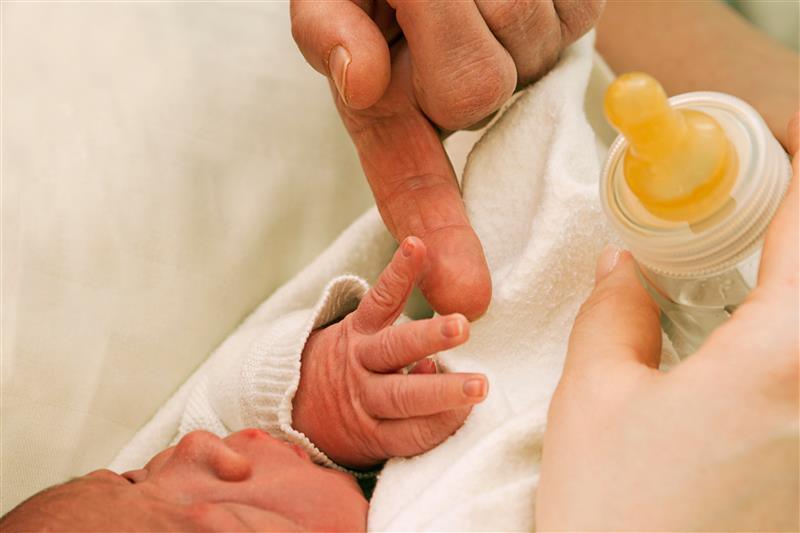
    A baby's hand touching the finger of an adult while the adult's other hand holding a baby bottle.
    Robert Chapkin, Ph.D., is leading research to study feeding intolerance in preterm infants. The Chapkin lab has developed a novel noninvasive method that allows for precise diagnosis of feeding intolerance severity. (Adobe Stock photo)

    When an infant has symptoms that suggest trouble digesting milk or formula, physicians work to rule out worst-case scenarios such as severe intestinal injury or necrotizing enterocolitis, NEC. A clinician’s response may involve stopping tube feedings, ordering serial abdominal radiographs and initiating broad-spectrum antibiotics. These interventions, however, could threaten an infant’s growth, gastrointestinal microbiome and neurocognitive development. 

    To test an intervention without these side effects, Robert Chapkin, Ph.D., Allen Endowed Chair in Nutrition and Chronic Disease Prevention, Department of Nutrition and Department of Biochemistry and Biophysics in the Texas A&M College of Agriculture and Life Sciences and Texas A&M AgriLife researcher, will lead research to apply a noninvasive method developed by the Chapkin lab. 

    New grant to assess neonatal gut

    The novel method developed by Chapkin enables researchers to assess the intestinal physiology of a baby, including an accurate determination of their nutrient absorption. By examining the intestinal cells exfoliated in the baby’s feces, clinicians will be able to noninvasively assess neonatal gut, which is the primary site of nutrient absorption and the host immune system. This assessment might help eliminate more limited or potentially harmful treatments. 

    “Believe it or not, clinicians basically still don’t really know what’s going on in these babies,” said Chapkin. “We developed a noninvasive methodology where we capture gene expression information, i.e., an mRNA molecular fingerprint, from intestinal cells that are exfoliated into the fecal stream.”

    Chapkin and his research team recently received a new five-year grant from the National Institutes of Health, NIH, for this project. The $3.9 million grant will help researchers assess the nutritional and clinical predictors of intestinal maturation and feeding intolerance in the preterm infant. 

    “This is the evolution of a long collaborative process where we are focusing on nutrition in newborn babies and, to some degree, babies who are born extremely premature,” said Chapkin. “The question is, what sort of nutrition do these children need for optimal health?”

     Sharon Donovan, Ph.D., Hagler Scholar, professor, Melissa M. Noel Endowed Chair in Nutrition and Health, and director of the Personalized Nutrition Initiative, University of Illinois Urbana-Champaign, is helping lead the grant. 

    Additional collaborators include Camilia Martin, M.D.,  division chief of neonatology, Weill Cornell Medicine; Sarah Taylor, M.D.,  professor of pediatrics and chief, section of neonatal-perinatal medicine, as well as director of clinical research, Yale School of Medicine; and Ivan Ivanov, Ph.D., research professor, Texas A&M University Department of Biomedical Engineering, and clinical professor, Texas A&M Department of Veterinary Physiology and Pharmacology

    Noninvasive method

    Feeding intolerance is a common occurrence in preterm infants and can signal a range of problems from minor issues to more serious ones like NEC. Determining the severity of a feeding intolerance is difficult, however, because clinicians are limited in the invasive tests they can perform on infants. 

    “We have some degree of knowledge what is in their gut, but we really don’t know how the baby is responding,” Chapkin said. “You can’t do a blood draw on these babies unless you have very specific protocols that are being approved because it is considered a highly vulnerable population.” 

    That is where the work of Chapkin’s research team and its noninvasive “precision exfoliomic” methodology come into play. 

    Chapkin said the team captures gene expression information from cells that are exfoliated or released through a normal process. The cells enter the fecal stream, where feces resides along with trillions of microbes. The cells are eventually passed naturally by the baby. 

    “We get molecular signatures, or biomarkers, on the baby in real time, and we are looking for information that will tell us what is going on in the baby’s immune system and if it is a normal healthy baby,” Chapkin said. 

    About the Chapkin lab

    Chapkin’s research has been continuously funded by the NIH for the past 35 years. Research in his lab focuses on dietary and microbial modulators related to the prevention of cancer and chronic inflammatory diseases. 

    -30-MEDIA INQUIRIES

    Laura Muntean
    laura.muntean@ag.tamu.edu
    601.248.1891

    Tim Schnettler

    Tim Schnettler

    tim.schnettler@ag.tamu.edu

    Tim Schnettler is a Web Communications Specialist with Texas A&M AgriLife Communications.

  • Nutritional and clinical predictors of intestinal maturation and feeding tolerance in the preterm infant

    ·

    Major Goals:  Annotate host exfoliated mucosal cell transcriptome, i.e., exfoliome, and fecal bacterial metagenome and metabolome profiles to identify biomarkers for preterm infants who have consistent tolerance to enteral feeding or who are diagnosed with feeding intolerance or ischemia.

    Status of Support: Active

    Project Number: RO1 HD112396-01

    Name of PD/PI:  Multi-PI Chapkin/Donovan

    Source of Support: NIH

    Primary Place of Performance:  Texas A&M University, College Station, Texas; and University of Illinois-Champaign

    Project/Proposal Start and End Date:  9/2023-8/2028

    Total Award Amount (including Indirect Costs):  $3,958,957

  • Texas A&M University Faculty Affairs

    ·

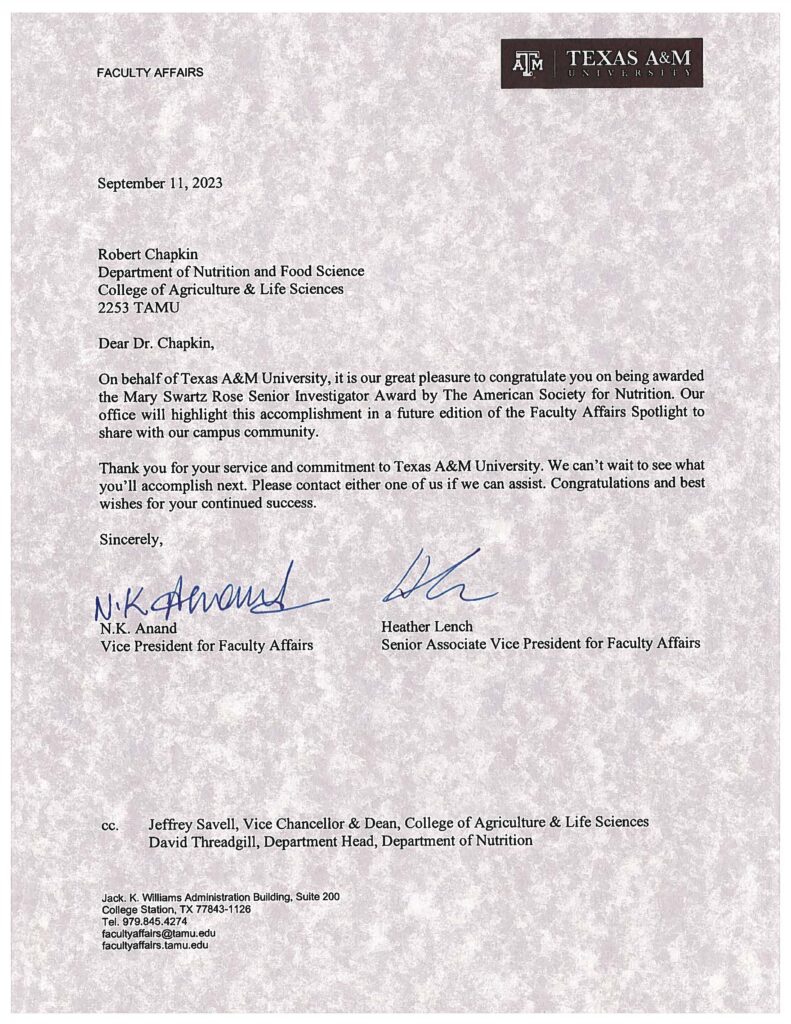
    Congratulates Dr. Robert Chapkin for ASN Award

    Letter of congratulations to Dr. Chapkin
  • BREAKTHROUGH IN Wnt SIGNALING PUBLISHED!

    ·