
Gut Stem Cell Biology
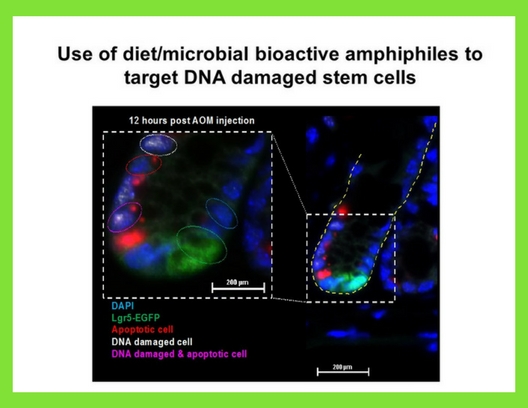
Use of Diet/Microbial Bioactive Amphiphiles to Target DNA Damaged Stem Cells.
Projects in this research area are designed to assess how the chemoprotective properties of dietary lipid are altered when a highly fermentable fiber, pectin, rather than a poorly fermentable fiber, cellulose, is added to the diet. This protective effect is mediated in part by the up-regulation of targeted apoptosis of DNA adducts during tumor initiation. Our findings indicate that highly fermentable fiber, which generates butyrate in the colon, only has chemotherapeutic value when n-3 PUFA is the lipid source. With respect to a molecular mechanism of action, n-3 PUFA and butyrate (a microbial fermentation product), in combination, synergistically induce a novel p53-independent, oxidation-sensitive, mitochondrial Ca2+-dependent (intrinsic) pathway. This critical observation emphasizes the need to examine both the lipid and fiber composition of diets. The lab is now focusing on the impact of gut-related metabolites on intestinal stem cell biology in vivo and ex vivo using a colonic organoid model system.
- M.E. Edwards, D.P. Freitas, E.A. Hirtzel, N. White, H. Wang, L.A. Davidson, R.S. Chapkin, Y. Sun and X. Yan. Interfacial electromigration for analysis of biofluid lipids in small volumes. Analytical Chemistry (In Press).
- A. Roitershtein, R. Rastegar, R.S. Chapkin and I. Ivanov. Extinction scenarios in evolutionary processes: a multinomial Wright-Fisher approach. Journal of Mathematical Biology 87:63, 2023. PMID:37751048, PMCID: PMC10586398
- A. Erazo-Oliveras, M. Muñoz-Vega, M. Mlih, V. Thiriveedi, M.L. Salinas, J.M. Rivera-Rodriguez, E. Kim, R.C. Wright, X. Wang, K. Landrock, J. Roper, J. Karpac and R.S. Chapkin. Mutant APC reshapes plasma membrane nanodomains by altering cholesterol levels via oncogenic β-catenin signaling. Nature Communications 14:4342, 2023. PMID:37468468, PMCID: PMC10356786
- Y. Yang, G. Li, Y. Zhong, Q. Xu, B. Chen, Y.T. Lin, R.S. Chapkin, J.J. Cai. Gene knockout inference with variational graph autoencoder learning for single-cell gene regulatory networks. Nucleic Acid Research 51:6378-6592, 2023. PMID:37246643, PMCID: PMC10359630
- X. Ma, X. Wang, L. Xu, H. Shi, H. Yang, K.K. Landrock, V.K. Sharma and R.S. Chapkin. Fate and distribution of orally ingested CeO2-nanoparticles based on a mouse model: implication for human health. Soil and Environment Health 1:100017, 2023. PMID: 37830053, PMCID: PMC10568217
- Y. Yang, G. Li, Y. Zhong, Q. Xu, Y. Lin, C. Roman, R.S. Chapkin and J.J. Cai. scTenifoldXct: a semi-supervised method for predicting cell-cell interactions and mapping cellular communication graphs. Cell Systems 14:302-311.e4, 2023. PMID: 36787742, PMCID: PMC10121998
- D. Zhao, M.B. Farnell, M.H. Kogut, K.J. Genovese, R.S. Chapkin, L.A. Davidson, L.R. Berghman and Y.Z. Farnell.From crypts to enteroids: Establishment and characterization of avian intestinal organoids. Poultry Science 101:101642, 2022. PMID: 35016046, PMCID: PMC8749297
- Bayesian biclustering for microbial metagenomic sequencing data via multinomial matrix factorization. Biostatistics. 2022 Jul 18;23(3):891-909. doi: 10.1093/biostatistics/kxab002. PubMed PMID: 33634824; PMCID: PMC9291645.
- . NIHMSID: NIHMS1822915.doi: 10.1007/s12561-022-09350-w
- R.S. Chapkin, S.L. Navarro, M.A.J. Hullar, and Johanna W. Lampe. Diet and gut microbes act coordinately to enhance programmed cell death and reduce colorectal cancer risk. Digestive Diseases and Sciences 2020 Mar;65(3):840-851. doi: 10.1007/s10620-020-06106-8. Review. PubMed PMID: 32006211; PubMed Central PMCID: PMC7605510.
- Kim E, Wright GA, Zoh RS, Patil BS, Jayaprakasha GK, Callaway ES, Ivanov I, Turner ND, R.S. Chapkin. Establishment of a multicomponent dietary bioactive human equivalent dose to delete damaged Lgr5+ stem cells using a mouse colon tumor initiation model. Eur J Cancer Prev. 2019 Sep;28(5):383-389. doi: 10.1097/CEJ.0000000000000465. PubMed PMID: 30234553; PubMed Central PMCID: PMC6422758.
- R.S. Chapkin. Robert Chapkin on Relationships Between the Gut Microbiome, Diet, and Colorectal Cancer. Oncology (Williston Park). 2018 May 15;32(5):248-9. PubMed PMID: 29847856.
- Triff, M. McLean, E. Callaway, J. Goldsby, I. Ivanov and R.S. Chapkin. Dietary fat and fiber interact to uniquely modify global histone post-translational epigenetic programming in a rat colon cancer progression model. Int J Cancer. 2018 Sep 15;143(6):1402-1415. doi: 10.1002/ijc.31525. Epub 2018 May 10. PubMed PMID: 29659013; PubMed Central PMCID: PMC6105390.
- Triff, M. McLean, K. Konganti, J. Pang, E. Callaway, B. Zhou, I. Ivanov and R.S. Chapkin. Assessment of histone tail modifications and transcriptional profiling during colon cancer progression reveals a global decrease in H3K4me3 activity. Biochimica et Biophysica Acta – Molecular Basis of Disease 1863:1392-1402, 2017. PMID:28315775. PMCID: PMC5474136
- E. Kim, L.A. Davidson, R.S. Zoh, M.E. Hensel, M.L. Salinas, B.S. Patil, G.K. Jayaprakasha, E.S. Callaway, C.D. Allred, N.D. Turner, B. Weeks and R.S. Chapkin. Rapidly cycling Lgr5+ stem cells are exquisitely sensitive to extrinsic dietary factors that modulate colon cancer risk. Cell Death & Disease 7:e2460, 2016. PMID:27831561, PMCID:PMC5260883
- Y.Y. Fan, L.A. Davidson, E.S. Callaway, G.A. Wright, S. Safe and R.S. Chapkin. A bioassay to measure energy metabolism in mouse colonic crypts, organoids and sorted stem cells. American Journal of Physiology-GI 309:G1-G9, 2015. PMID: 25977509,PMCID:PMC4491508
- V. DeClercq, D.N. McMurray and R.S. Chapkin. Obesity promotes colonic stem cell expansion during cancer initiation. Cancer Letters 369:336-343, 2015. PMID:26455770, PMCID: PMC4636003
- L.A. Davidson, E. Callaway, E. Kim, B. Weeks, Y.Y. Fan, C.D. Allred and R.S. Chapkin. Targeted deletion of p53 in Lgr5-expressing intestinal stem cells promotes colon tumorigenesis in a preclinical model of colitis-associated cancer. Cancer Research 75:5392-5397, 2015. PMID:26631266 PMC4681667
- Shah, E. Kim, L.A. Davidson, J.M. Knight, R. Zoh, J.S. Goldsby, E.S. Callaway, B. Zhou, I. Ivanov and R.S. Chapkin. Comparative effects of diet and carcinogen on mircoRNA expression in the stem cell niche of the mouse colonic crypt. Biochimica et Biophysica – Molecular Basis for Disease 1862:121-134, 2015. PMID:26493444 PMC4674324
- Y.Y. Fan, L.A. Davidson, E.S. Callaway, J.S. Goldsby and R.S. Chapkin. Differential effects of 2 and 3-series prostaglandins on in vitro expansion of Lgr5+ intestinal stem cells. Carcinogenesis 35:606-612, 2014. PMID:24336194 PMCID: PMC3941743
- L.A. Davidson, J.S. Goldsby, E.S. Callaway, M. Shah, N. Barker and R.S. Chapkin. Alteration of colonic stem cell gene signatures during the regenerative response to injury. Biochmicia et Biophysica Acta-Molecular Basis of Disease 1822:1600-1607, 2012. PMID: 22750333 PMCID:PMC3418394
- Y.Y. Fan, Y. Tian, L.A. Davidson, L. Zhou, E. Callaway, B.R. Weeks, S. Toyokuni, J.R. Lupton, and R.S. Chapkin. Proapoptotic effects of n-3 fatty acids are enhanced in SOD2 knockout mouse colon. Journal of Nutrition 139:1328-1332, 2009. PMID: 19458032 PMCID: PMC2696987
- C. Crim, L. Sanders, M.Y. Hong, S. Taddeo, N.D. Turner, R.S. Chapkin and J.R. Lupton. Upregulation of p21waf1/cip1 expression in vivo by butyrate administration can be chemoprotective or chemopromotive depending on the lipid component of the diet. Carcinogenesis 29:1415-1420, 2008. PMID: 18567619 PMCID: PMC2659529
- S. Kolar, R. Barhoumi, J.R. Lupton and R.S. Chapkin. Docosahexaenoic acid and butyrate synergistically induce colonocyte apoptosis by enhancing mitochondrial Ca2+ accumulation. Cancer Research 67:561-5568, 2007. PMID:17545640.
- S.S. Kolar, R. Barhoumi, E.S. Callaway, Y.Y. Fan, N. Wang, J.R. Lupton and R.S. Chapkin. Synergy between docosahexaenoic acid and butyrate elicits p53-independent apoptosis via mitochondrial Ca2+ accumulation in human colon cancer cells and primary cultures of rat colonic crypts. American Journal of Physiology: GI and Liver Physiology 293:G935-G943, 2007. PMID: 17717041 PMCID: PMC4669682
- Y. Ng, R. Barhoumi, R.B. Tjalkens, Y.Y. Fan, S. Kolar, N. Wang, J.R. Lupton and R.S. Chapkin. The role of docosahexaenoic acid mediating mitochondrial membrane lipid oxidation and apoptosis in colonocytes. Carcinogenesis 26:1914-1921, 2005. PMID: 15975958 PMCID: PMC4477626
- M.Y. Hong, J.R. Lupton, J.S. Morris, N. Wang, R.J. Carroll, L.A. Davidson, R.H. Elder and R.S. Chapkin. Dietary fish oil reduces DNA adduct levels in rat colon in part by increasing apoptosis during tumor initiation. Cancer Epidemiology Biomarkers and Prevention 9:819-826, 2000. PMID: 10952099
- W.C.L. Chang, R.S. Chapkin and J.R. Lupton. Fish oil blocks azoxymethane-induced tumorigenesis by increased cell differentiation and apoptosis rather than decreased cell proliferation. Journal of Nutrition 128:491-497, 1998. PMID: 9482754
- D.Y. Lee, J.R. Lupton, H.M. Aukema and R.S. Chapkin. Dietary fat and fiber alter rat colonic mucosal lipid mediators and cell proliferation. Journal of Nutrition 123:1808-1817, 1993. PMID: 8229295
