
Research in the Chapkin lab focuses on dietary/microbial modulators related to the prevention of cancer and chronic inflammatory diseases. The lab has been continuously funded by the National Institutes of Health (NIH) for the past 38 years.
Most Recent ASN Achievement: Dr. Chapkin named American Society for Nutrition 2024 Fellow
Most Recent NIH Award: Nutritional and clinical predictors of intestinal maturation and feeding tolerance in the preterm infant


Dr. Robert S. Chapkin Recent Happenings
Dr. Robert Chapkin appointed as Distinguished Professor in 2014 has been elected to serve on the Executive Committee of the Distinguished Professors (ECDP) for a 3 year term. The University Distinguished Professor designation is bestowed upon Texas A&M University faculty members who are preeminent in their fields and have made transformational contributions – or provided an intellectually substantial “leap forward” – in their discipline. This is the highest achievement a faculty member can earn at TAMU, and demonstrates his high quality of scholarship. Dr. Chapkin is a preeminent authority in Nutrition and Chronic Disease Prevention.
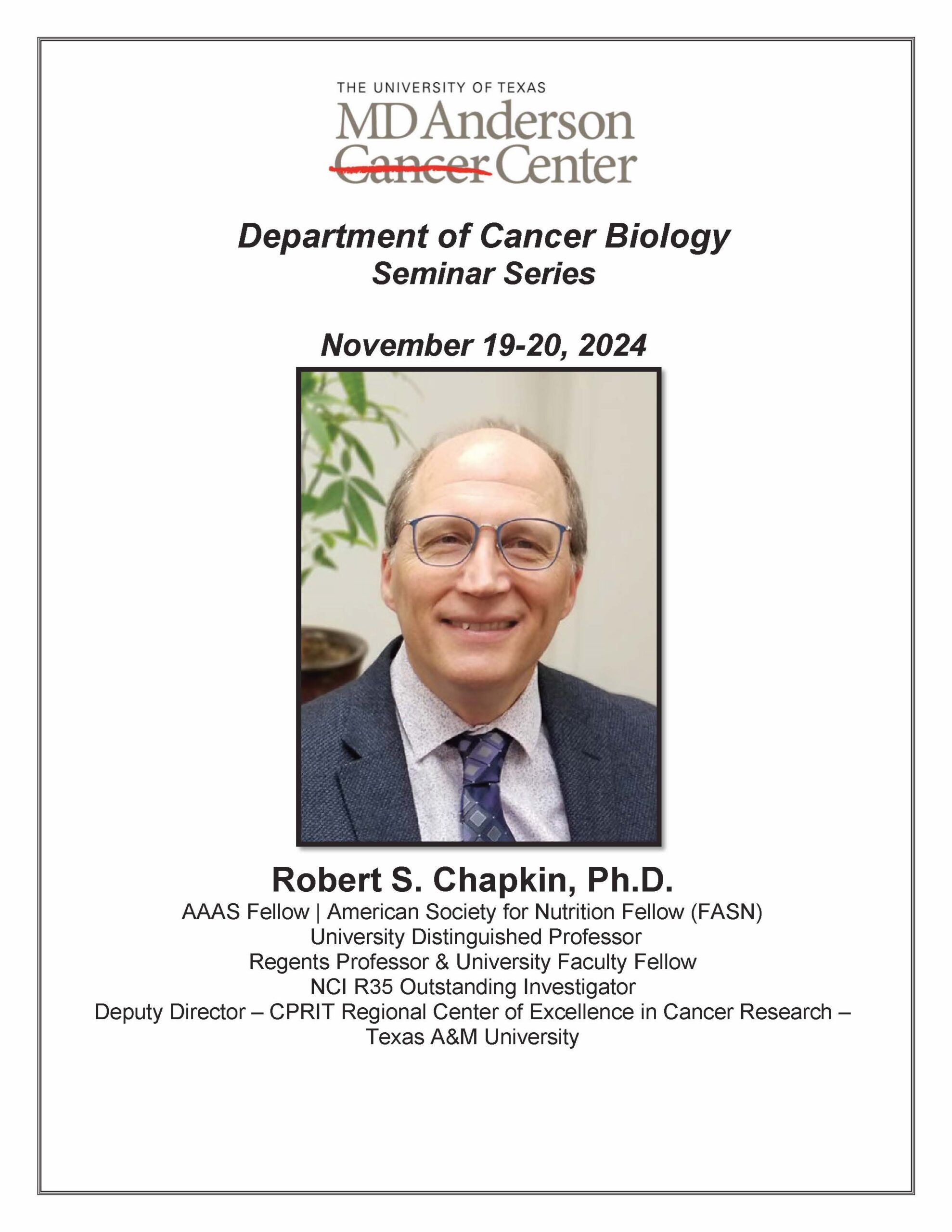
Presentation: “Targeting Plasma Membrane Spatial Dynamics to Suppress Aberrant Wnt Signaling”
Chapkin Lab Research Happenings
In a recent groundbreaking publication, “Pesco-Vegetarian Food Components Promote Colonocyte Ferroptosis in Preclinical Mouse Models and a Randomized Crossover Trial in Healthy Human Adults”, Dr. Yang-Yi Fan documented the combined effects of ω-3 long-chain PUFA and highly fermentable fiber (in mouse models and humans) with respect to alterations in critical pathways important to CRC prevention, particularly intrinsic mitochondrial-mediated programmed cell death resulting from the accumulation of lipid reactive oxygen species (ferroptosis). This is noteworthy, because ferroptosis is a form of regulated cell death characterized by the accumulation of lipid hydroperoxides that has emerged as a target for anticancer therapies.
Conclusion: These findings demonstrate that dietary fish oil and fermentable fiber combination induces ferroptosis exclusively in colonocytes in humans. This innovative work suggests that low intakes of fiber and w-3 PUFA in Western populations, and the failure to address an interaction, may explain why the chemoprotective effects of w-3 PUFA and fermentable fibers are not detected consistently in prospective cohort studies


Proposed mechanism by which fish and fermentable fiber combination induce ferroptosis specifically in colonocytes.

Diet therapy abates mutant APC and KRas effects by reshaping plasma membrane cholesterol nanodomains
Eunjoo Kim, Alfredo Erazo-Oliveras, Mo´nica Mun˜oz-Vega, Natividad R. Fuentes, Michael L. Salinas, Miranda J. George, Roger S. Zoh, Martha E. Hensel, Bhimanagouda S. Patil, Ivan Ivanov, Nancy D. Turner, and Robert S. Chapkin
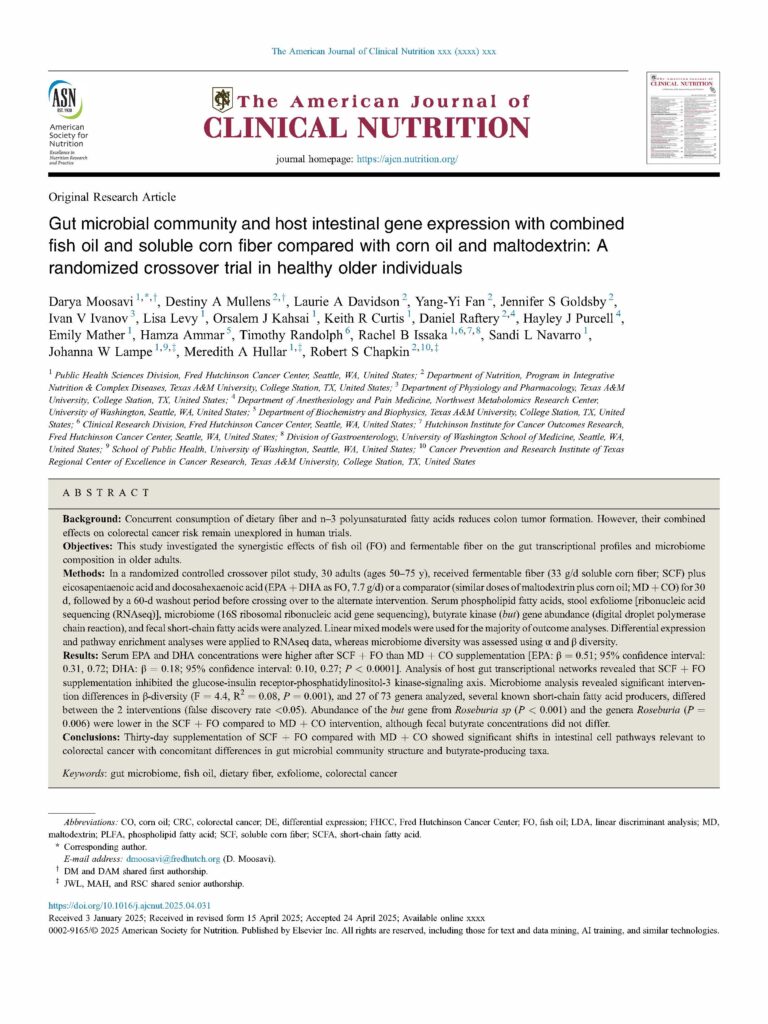
Darya Moosavi, Destiny A Mullens, Laurie A Davidson, Yang-Yi Fan, Jennifer S Goldsby, Ivan V Ivanov, Lisa Levy, Orsalem J Kahsai, Keith R Curtis, Daniel Raftery, Hayley J Purcell, Emily Mather, Hamza Ammar, Timothy Randolph, Rachel B Issaka, Sandi L Navarro, Johanna W Lampe, Meredith A Hullar, Robert S Chapkin
We are excited to share our recent publication aimed to characterize circulating immune cell subpopulation gene expression in human milk-fed compared to cow’s milk formula-fed infants using single-cell transcriptomics. We demonstrate for the first time that human milk downregulates peripheral immune cell cytokine transcriptional signatures linked to allergic inflammation and infection relative to formula feeding.
Background: Several studies have indicated the benefits of human milk feeding to infants however, mechanisms behind positive health outcomes have not been investigated.
Objectives: The study aimed to characterize circulating immune cell subpopulation gene expression in human milk-fed (HMF) compared with cow milk formula-fed (FF) infants using single-cell transcriptomics.
Chapkin Lab Graduate Research Student earns her Ph.D.

We would like to congratulate Destiny Mullens for successfully defending her dissertation “Utilizing Synthetic Data to Enhance Biological Assessment of Bulk RNA Sequencing Data” on Wednesday, September 17, 2025, for her PhD in Biomedical Sciences. She was mentored by Drs. Ivan Ivanov and Robert Chapkin. Destiny has published 5 papers to date, with several currently in review. We look forward to seeing more exciting work from her!
Chapkin Lab Undergraduate Student Awards
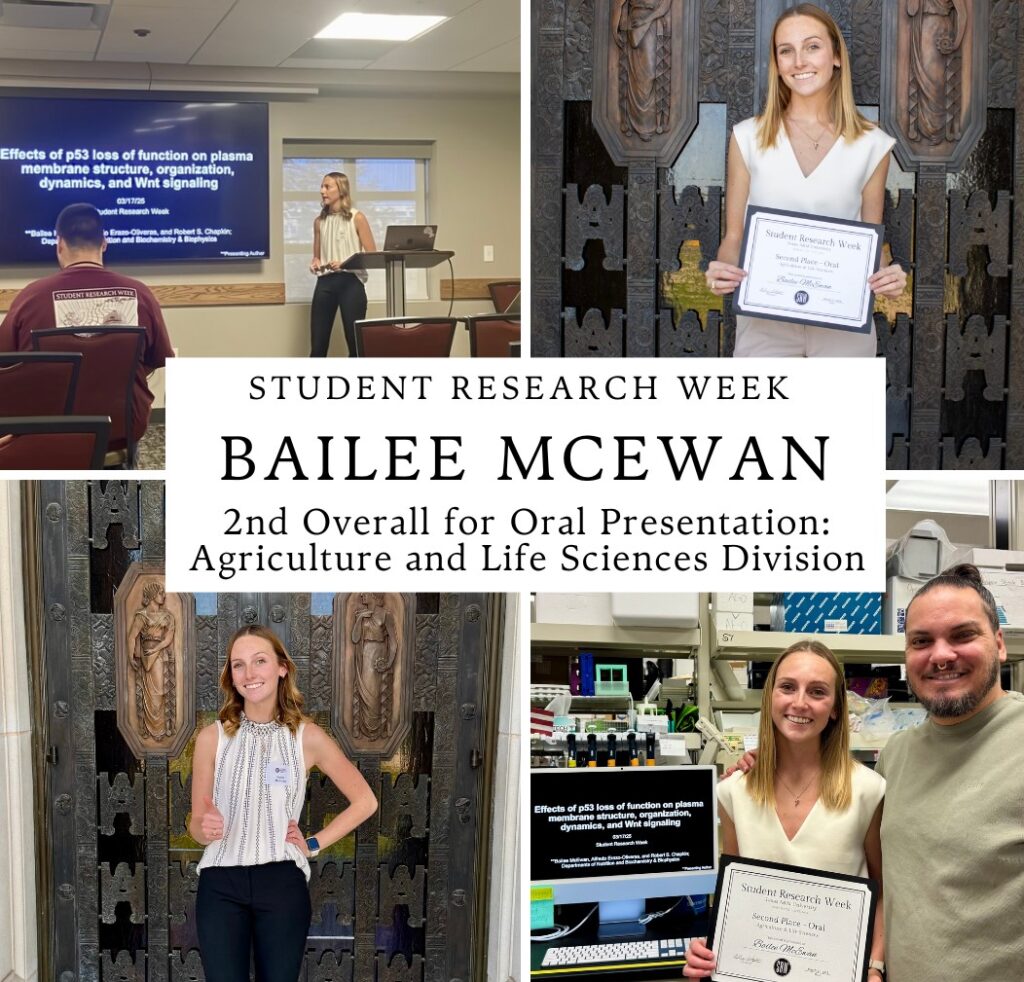
Chapkin Lab is proud to recognize Bailee McEwan’s Award for Student Research Week: 2nd Overall for Oral Presentation. She presented “Effects of p53 loss of function on plasma membrane structure, organization, dynamics, and Wnt signaling”. Bailee comes to our lab with an interest in oncology and pursuing a career in medicine.
Texas Regional Center of Excellence in Cancer Research – TREC
TREC EVENTS
- March 2, 2026: Dr. Kai Kessenbrock – Genetics/Genomics & TREC Seminar
- 4-5pm
- Biochemistry & Biophysics Building #108
- No cell is an island – the role of the microenvironment in breast cancer initiation and progression
- Zoom: TREC Seminar – Dr. Kai Kessenbrock
- March 30, 2026: Dr. Omer Yilmaz – Nutrition Seminar (co-sponsored by TREC)
- 11:30am-12:30pm
- Kleberg, Rm 127
- Dietary Control of Stem Cells in Physiology and Disease
- April 2, 2026: 4th Annual TREC Symposium: Advances in Cancer Research
- 1pm
- The Stella Hotel
- Registration: tx.ag/TREC2026
Previous Event Information
- October 31, 2024: Jenna Mueller, UMD
- November 14, 2024: Dr. Jennifer Cullen, Houston Methodist Neal Cancer Center
- April 4, 2025: 3rd Annual TREC Symposium @ Texas A&M Hotel and Conference Center
- September 18, 2025: Dr. Kenneth Ramos – TREC Two-Year Update
- October 22, 2025: Dr. James Cai & Dr. Yang Ni – “Advancing Cancer Research Through Single-Cell Data Science: Two Years of Progress and the Road Ahead”
- February 10, 2026: Dr. Ralph DeBerardinis – TiCER 2026 Spring Symposium (co-sponsored by TREC)
RECENT NEWS:
- American Society for Nutrition Foundation Announces Class of 2024 Fellows
 April 1, 2024 by ASN Staff ASN’s Class of 2024… Read more: American Society for Nutrition Foundation Announces Class of 2024 Fellows
 - Texas A&M AgriLife researcher receives $4 million grant to study feeding intolerance in preterm infants
 Novel noninvasive method allows for precise diagnosis of feeding intolerance… Read more: Texas A&M AgriLife researcher receives $4 million grant to study feeding intolerance in preterm infants
 - Nutritional and clinical predictors of intestinal maturation and feeding tolerance in the preterm infant
 Major Goals: Annotate host exfoliated mucosal cell transcriptome, i.e., exfoliome,… Read more: Nutritional and clinical predictors of intestinal maturation and feeding tolerance in the preterm infant
 - Texas A&M University Faculty Affairs
 Congratulates Dr. Robert Chapkin for ASN Award
 - BREAKTHROUGH IN Wnt SIGNALING PUBLISHED!
 Breakthrough publication! Our recent paper in Nature Communications explains the… Read more: BREAKTHROUGH IN Wnt SIGNALING PUBLISHED!
FOLLOW US ON X (formerly known as Twitter) @ChapkinLab
Congrats to the 2023 Mary Swartz Rose Investigator Awardees, shown here at the @nutritionorg #Nutrition2023 event in Boston yesterday! These awards are given for outstanding #research on the #safety & efficacy of bioactive compounds for human #health. ASN Article Twitter Picture
CRN (@CRN_Supplements) July 24, 2023
Mutant APC reshapes Wnt signaling plasma membrane nanodomains by altering cholesterol levels via oncogenic β-catenin
The Chapkin Lab (@ChapkinLab) August 23, 2023
PubMed Link
