April 1, 2024 by ASN Staff
ASN’s Class of 2024 Fellows will be honored in Chicago at NUTRITION 2024, the largest nutrition meeting of the year.
Rockville, MD (April 1, 2024) – The American Society for Nutrition (ASN) and ASN Foundation are thrilled to announce the 15 distinguished luminaries who will be inducted into the ASN Class of 2024 Fellows. Induction as a Fellow of the Society is the highest accolade bestowed by ASN, honoring individuals for their significant contributions and outstanding lifetime achievements in the field of nutrition.
“We are excited to introduce the newest class of ASN Fellows. These individuals have devoted themselves to advancing our discipline and improving global health,” remarked ASN President, Kevin Schalinske, PhD. “Their work has paved the path for future generations of scientists, clinicians, and scholars.”
“The ASN Foundation extends heartfelt congratulations to the ASN Class of 2024 Fellows and expresses deep appreciation for their unwavering commitment to propelling our scientific domain and the Society forward,” said Catherine E. Woteki, PhD, Chair of the ASN Foundation Board of Trustees. “We look forward to celebrating their remarkable achievements at NUTRITION 2024, taking place June 29 – July 2 in Chicago.”
The ASN Class of 2024 Fellows
Mona S. Calvo, PhD, Icahn School of Medicine at Mount Sinai
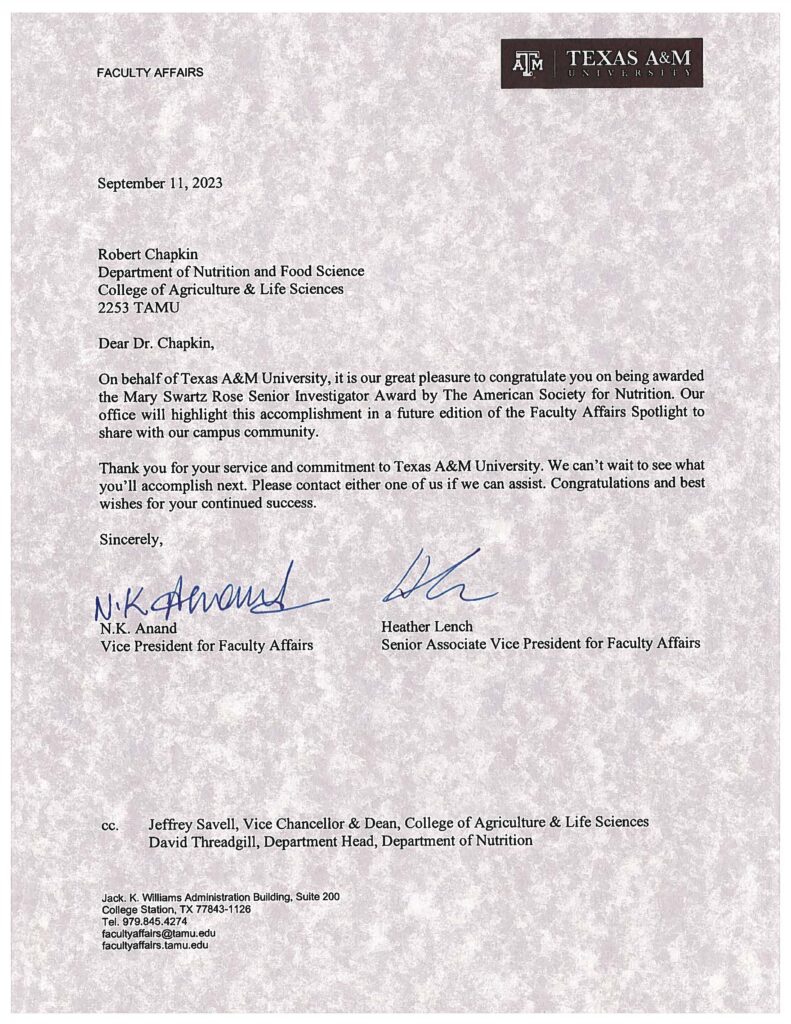
Robert S. Chapkin, PhD, Texas A&M University
Elvira de Mejía, PhD, University of Illinois Urbana-Champaign
Earl H. Harrison, PhD, Ohio State University
Christiani Jeyakumar Henry, PhD, Agency Science, Technology and Research, Singapore
Paul F. Jacques, DSc, USDA Human Nutrition Research Center on Aging at Tufts University
Donald K. Layman, PhD, University of Illinois Urbana-Champaign
Harris R. Lieberman, PhD, U.S. Army Research Institute of Environmental Medicine
Eric L. Lien, PhD, University of Illinois Urbana-Champaign
J. Alfredo Martínez Hernández, PhD, PharmD, MD, University of Navarra, Spain
Luis A. Mejía, PhD, University of Illinois Urbana-Champaign
John R. Speakman, PhD, DSc, University of Aberdeen, United Kingdom
Valerie Tarasuk, PhD, University of Toronto, Canada
Nimbe Torres, PhD, Salvador Zubirán National Institute of Health Sciences and Nutrition, Mexico
Armando R. Tovar, PhD, Salvador Zubirán National Institute of Health Sciences and Nutrition, Mexico
The induction of the Class of 2024 Fellows underscores ASN’s dedication to recognizing excellence and fostering advancements in the field of nutrition. The ASN Class of 2024 Fellows will be honored at the Fellows, Past Presidents, and 50-Year Member Luncheon held on June 30 from 11:30 AM to 1:30 PM at the Hyatt Regency McCormick Place during ASN’s annual flagship meeting, NUTRITION 2024. Members of this year’s class join more than 500 other ASN Fellows who have been recognized since the program began in 1952. For more information about ASN, the ASN Foundation, and the Class of 2024 Fellows, visit the ASN website.
About the American Society for Nutrition (ASN)
The American Society for Nutrition (ASN) is the preeminent professional organization for scientists and clinicians around the world. Founded in 1928, the society brings together the top nutrition researchers, medical practitioners, policy makers and industry leaders to advance the science, education, and practice of nutrition, reaching more than 55 million people annually. ASN publishes four peer-reviewed journals and provides education and professional development opportunities year-round. Since 2018, the American Society of Nutrition has presented NUTRITION, the leading global annual meeting for nutrition professionals. Visit us at nutrition.org.
About the ASN Foundation (ASNF)
The American Society for Nutrition Foundation (ASNF) complements and enhances ASN priorities and activities through the dissemination and application of nutrition science and education to improve public health and clinical practice worldwide, and advancing the Society’s role as a global leader in nutrition, health, and wellness. The ASNF’s broad portfolio of activities includes education, awards and scholarships, as well as recognition of lifetime achievement through our renowned Fellows program. The ASNF also raises funds to turn current challenges facing the field into opportunities that support the future. Visit us at nutrition.org/foundation.