Category: Lab News
-
John Kyung Ho Jung to receive graduation honors
John Jung from the Chapkin Lab has fulfilled all requirements for the 2019-2020 Undergraduate Research Scholar (URS) thesis program. After graduation from Texas A&M University, John will be recognized as an Undergraduate Research Scholar on his official transcript. John will also receive an Undergraduate Research Scholars medallion to wear as graduation regalia. In the lab,…

-
Hagler Fellow Induction
Dr. Sharon Donovan, Professor and Melissa M. Noel Endowed Chair in Nutrition and Health, Department of Nutritional Sciences, College of Agricultural, Consumer & Environmental Sciences, University of Illinois at Urbana-Champaign, has been awarded a Hagler Fellowship at Texas A&M University. Dr. Donovan’s laboratory conducts research in pediatric nutrition, focusing on optimizing neonatal intestinal and gut microbial development with respect tocognition…

-
AICR Interview with Chapkin on AhR Microbes
Under the Microscope: AhR Microbes Holding the Keys to Your Gut Health? “It’s really very predominantly a nutritional story,” says Texas A&M’s Dr. Robert Chapkin, describing one of his current passions — the aryl hydrocarbon receptor (AhR) signaling system that exists in every cell. It works like a lock and key. When natural keys, or…

-
New NIH Grants
Some recent good fortune for the Chapkin Lab in the past few months. We are pleased to report that a new NIH R21CA245456 grant “Diet and the colonic exfoliome: A novel, non-invasive approach to testing interventions in humans”, which leverages our novel non-invasive transcriptomics (exfoliomics) platform in relation to humans fed a chemoprotective diet, was funded…

-
Chapkin and Collaborators discuss colorectal cancer prevention
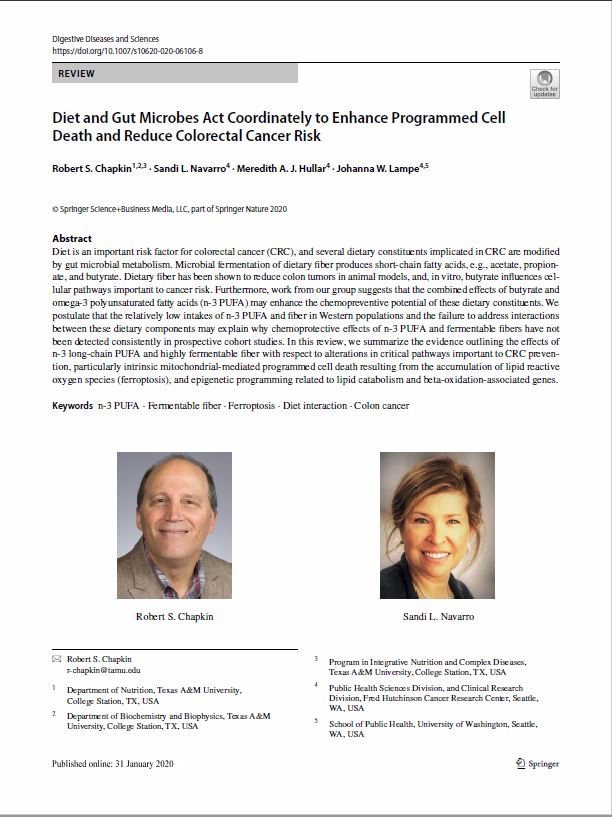
Chapkin et al discuss how several dietary constituents implicated in colorectal cancer are modified by gut microbial metabolism, and how highly fermentable fiber and n-3 long-chain polyunsaturated fatty acids (PUFAs) may alter critical pathways critical to colorectal cancer prevention.